News
A New Scientific Publication from the PROTINNOV Project: Gaining a Better Understanding of the Impact of High-Pressure Technologies on Pea Proteins
A new scientific publication highlights the work carried out as part of the PROTINNOV project, a collaborative research project coordinated by CELABOR and aimed at supporting innovation in the field of food proteins.
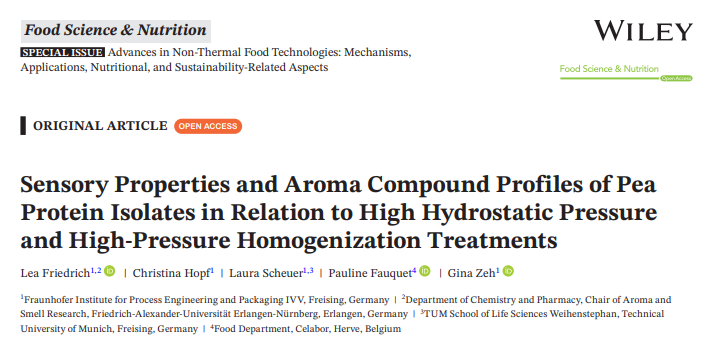
Conducted by our research partner, Fraunhofer IVV, the study has just been published in the international scientific journal Food Science & Nutrition. It investigates the impact of two innovative processing technologies — High Hydrostatic Pressure (HHP), also known as High-Pressure Processing (HPP), and High-Pressure Homogenization (HPH) — on the sensory and functional properties of pea protein isolates.
Improving Plant Protein Performance While Preserving Sensory Quality
Plant proteins, and pea proteins in particular, represent a promising alternative to animal proteins in the development of more sustainable foods. However, their use can sometimes be limited by certain sensory properties, including undesirable flavour notes, as well as by technological challenges related to their processing and incorporation into complex food matrices.
In this study, we investigated the extent to which high-pressure treatments could modify the characteristics of pea proteins, particularly their flavour profile. The results show that these technologies can modify certain functional properties of the proteins while maintaining a broadly similar overall sensory profile.
These findings open up interesting prospects for the use of gentle and innovative processing technologies to improve the functionality of plant proteins without compromising their sensory acceptability — a key challenge in the development of next-generation plant-based food products.
Collaboration Driving Food Innovation
This publication highlights the importance of collaborative research projects in addressing the current challenges facing the food industry. By bringing together the complementary expertise of research centres and industrial partners, the PROTINNOV project contributes to generating new knowledge and accelerating the development of innovative solutions for the food proteins of the future.
CELABOR is proud to have coordinated this project and would like to thank all the partners involved for their expertise and commitment to this collaborative initiative, as well as SPW – Economy, Employment, Research, which contributed to its funding.
📖 Read the full scientific article: