News
Launch of the European MycoStruct Project: Celabor at the Heart of Innovation for Tomorrow’s Proteins
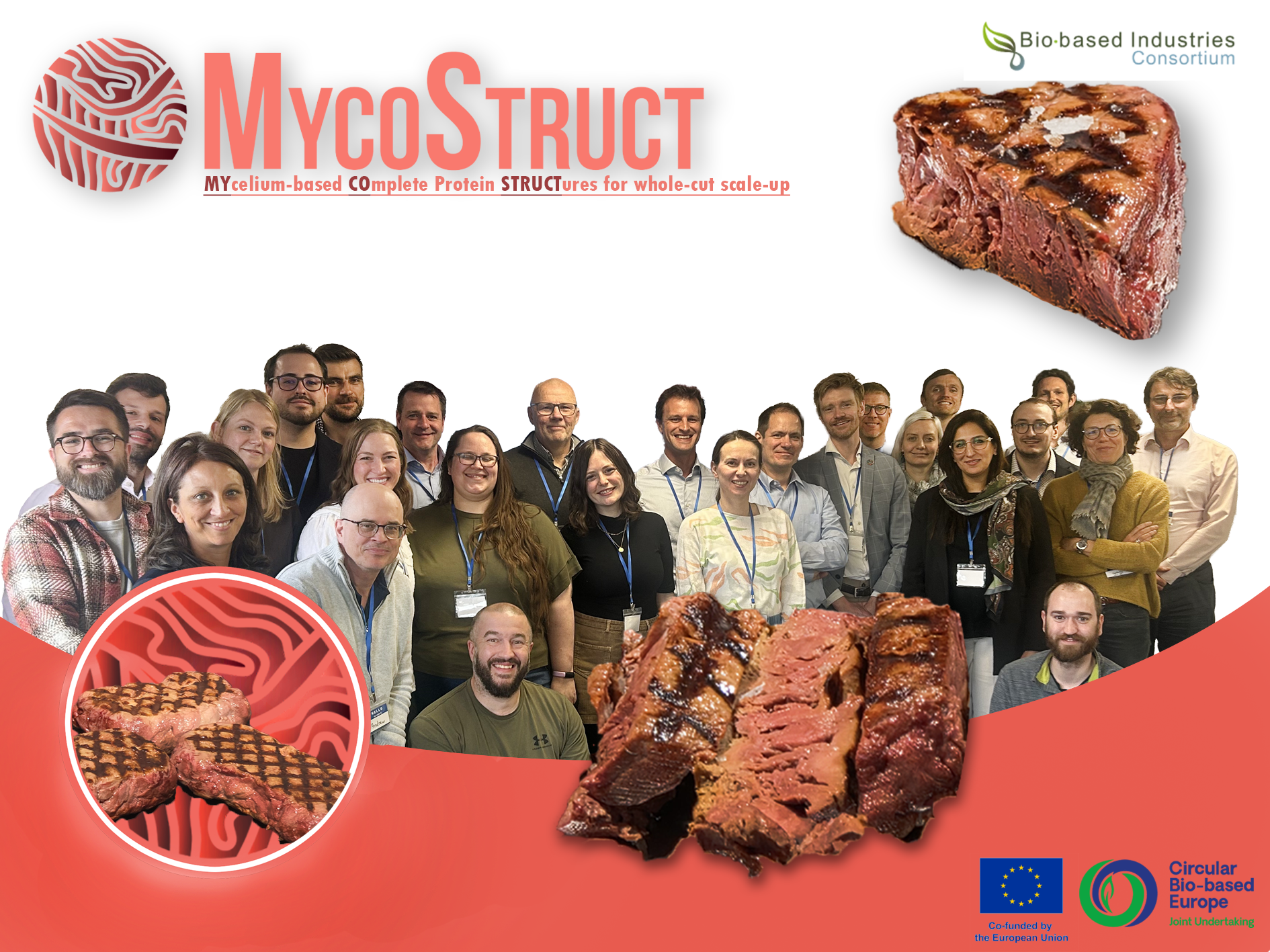
Europe is facing a historic challenge: transforming its food system to develop new protein sources that are sustainable, highly nutritious, locally produced and affordable. It is in this crucial context that the official kick-off meeting marking the launch of MycoStruct was held in Nottingham, England.
The project is part of the Circular Bio-based Europe Joint Undertaking (CBE-JU) programme and brings together a consortium of 12 industrial, academic and research partners from across Europe, including Adamo Foods, TFTAK, Bühler and TU Delft.
The MycoStruct Challenge: Textured Mycelium to Replace Meat
The MycoStruct project (MYcelium-based COmplete Protein STRUCTures for whole-cut scale-up) aims to revolutionise the meat alternative market. MycoStruct seeks to scale up the production of whole-cut products, such as plant-based steaks, to an industrial level.
The main objective is to support the development and industrial scale-up of innovative mycelium-based protein structures for whole-cut applications, such as alternative steaks. Thanks to a unique fermentation process that produces a naturally fibrous structure mimicking the texture and bite of meat, MycoStruct aims to deliver products combining an appealing texture, nutritional quality and functionality, while offering a clean-label formulation, without chemical additives or artificial binders.
Celabor’s Key Role: Ensuring Safety, Nutrition and Sustainability
As part of this international consortium, Celabor is involved as a Work Package Leader, leveraging its state-of-the-art facilities and multidisciplinary scientific expertise. Our research centre’s involvement focuses on three key strategic areas that are essential to the product’s commercial viability:
1. Rigorous Food Safety Control
Consumer safety is the top priority. Celabor is drawing on its analytical expertise to validate the compliance of the entire production chain. Our laboratory monitors for the presence of chemical and environmental contaminants, both in the raw materials used to feed the mycelium (industrial by-products) and in the finished products.
Our analyses target, for example:
- Mycotoxins
- Polycyclic Aromatic Hydrocarbons (PAHs)
- Heavy metals and other undesirable residues
2. Nutritional Value Characterisation
The product developed through MycoStruct should not only be tasty and have an appealing texture; it should also offer significant nutritional value. The targeted mycelium is expected to provide a complete amino acid profile and excellent digestibility.
Celabor is responsible for studying the final nutritional composition — including proteins, fibres, vitamins, minerals, etc. — to ensure a healthy, balanced food product with high added value for consumers’ health.
3. Final Packaging
Our Materials Department is involved in determining and developing the most suitable packaging for these future mycelium-based steaks. The objective is twofold: to ensure optimal barrier protection to preserve freshness and extend the product’s shelf life, while also meeting the European Union’s stringent eco-design and sustainability requirements.
4. Shelf-Life Study of the Plant-Based Steaks
Celabor will also conduct a shelf-life study of the mycelium-based steaks in their final packaging and formulation, under both chilled and frozen storage conditions.
On the Road to Market
By the end of the project, production will move from the pilot stage to a large-scale industrial demonstration unit. Through the synergy of its partners and Celabor’s scientific expertise, MycoStruct is laying the foundations for a more resilient, sustainable and forward-looking European food system.