News
🚀 Horizon Europe: Celabor secures 5 major new projects to accelerate the ecological transition
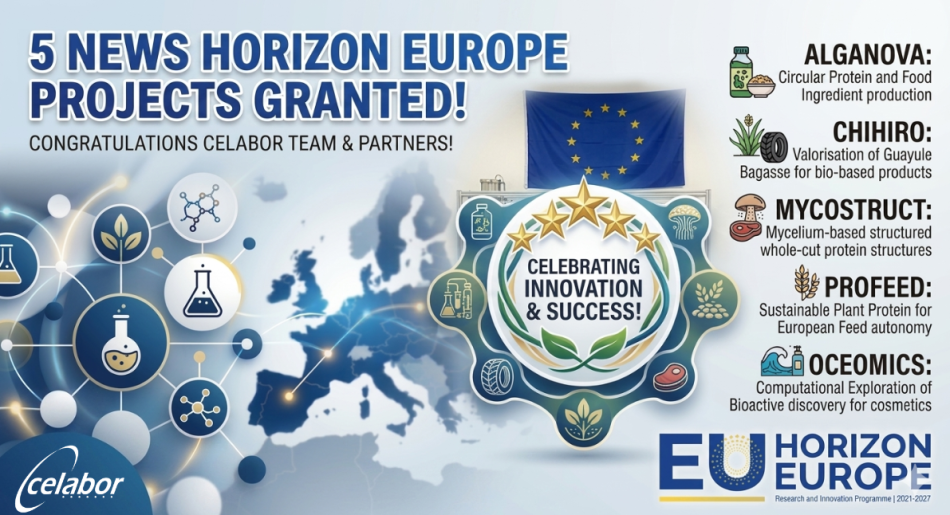
This is a historic milestone for Celabor. Our research center has just officially signed the Grant Agreements for 5 major Horizon Europe projects. Confirming the strength of our 4 technological pillars, these successes are propelling our teams into a marathon of sustainable innovation for the 2026–2030 period, supported by €1.94 million in funding.
Following an intense year in 2025, during which our scientists helped prepare 24 proposals, Celabor achieved an exceptional success rate of 26%, well above the European average. The projects will officially start between May and October 2026, for an average duration of 45 months.
From the laboratory (TRL 4–5) to the industrial demonstrator (TRL 7), Celabor is more than ever establishing itself as a key link in the bioeconomy and the ecological transition in Europe. Discover the details, objectives, and technological challenges of these 5 future-focused projects.
🚗 CHIHIRO: Towards a European sustainable rubber value chain thanks to guayule (TRL 5)
Funded by Horizon CBE-JU
The CHIHIRO project tackles a strategic challenge: reducing Europe’s dependence on natural rubber imports. The objective is to pave the way for the production of new bio-based materials from bagasse (woody residue) and guayule resin, a resilient plant grown locally.
- The cascading biorefinery concept: The project aims to valorize nearly 100% of guayule biomass by processing all its fractions (latex, resin, bagasse). The co-products that are currently underutilized will notably be used to produce bio-based, ultra-high-performance thermoplastic elastomers (TPE).
- What is at stake for Celabor: Converting currently underutilized co-products into high-performance, bio-based thermoplastic elastomers (TPE), directly contributing to the establishment of a viable and sustainable rubber value chain in Europe.
🌿 ALGANOVA: A microalgae biorefinery serving tomorrow’s food (TRL 7)
Funded by Horizon CBE-JU
ALGANOVA aims to produce food proteins and high value-added functional ingredients from microalgal biomass, following a circular, “zero-waste” model.
- A circular and innovative cultivation approach: The project will implement a parallel cultivation strategy, both autotrophic (using industrial CO2 emissions as inorganic carbon for photosynthesis) and heterotrophic (using by-products from the agro-marine industry as substrates and sources of organic carbon).
- Technologies and deliverables: The process will cover input pre-treatment, cultivation, harvesting, cell disruption, as well as extraction and purification of target compounds (protein extracts, polyunsaturated fatty acids (PUFA), carotenoids). Celabor and its partners will use cutting-edge digital tools (digital twins, genome-scale metabolic models, automated control systems) to optimize bioprocesses and facilitate scale-up to industrial level. The ingredients will be incorporated into food prototypes to assess their nutritional and sensory properties and safety, in strict compliance with EU regulations.
🍄 MycoStruct: Impressive, non-ultra-processed meat alternatives (TRL 7)
Funded by Horizon CBE-JU
The MycoStruct project addresses the limitations of current meat substitutes by developing a breakthrough technology based on liquid mycelium fermentation to create “whole-cut” formats (whole-cut).
- A healthy, simple alternative: Unlike existing products, often criticized for their complexity and level of processing, MycoStruct delivers an ultra-realistic texture, exceptional digestibility, and high protein content, all with a minimalist ingredient list.
- Valorization of agricultural by-products: While initial laboratory tests will use corn sugar, the process will quickly shift to co-products from European agriculture, such as corn starch cakes, potato processing waste, and alfalfa silage.
🌾 ProFEED: Boosting Europe’s protein autonomy for animal feed (TRL 5)
Funded by Horizon Cluster 6
In response to food sovereignty challenges, ProFEED aims to strengthen the European Union’s self-sufficiency in plant proteins for animal feed, through crop science, digital tools, and participatory demonstrations.
- A large-scale multi-actor approach: Deployed in 9 countries, the project involves 40 farmers, 10 flagship sites (Lighthouse Sites), and 4 communities of practice. More than 130 soybean, lupin, and alfalfa varieties will be screened in state-of-the-art growth chambers to identify those most resilient to climate change.
- Extraction and formulation (Celabor’s expertise): Low environmental-impact processing technologies will be developed to improve the nutritional quality of the extracts. The formulations will be validated through waves of trials on pigs, broiler chickens, laying hens, gilthead seabream, and Atlantic salmon, with the objective of reducing dependence on soybean meal by up to 30%. A digital decision-support platform and a multilingual MOOC will ensure the widespread adoption of these solutions by the sector.
🌊 OCEOMICS: AI and blue biotechnology for precision cosmetics (TRL 7)
Funded by Horizon Cluster 6
The OCEOMICS project combines the power of artificial intelligence and marine biotechnologies to explore deep-sea biodiversity and discover the cosmetic actives of the future.
- Multidisciplinary bioprospecting: By integrating computational screening (AI), metabolic engineering, bioproduction, and purification, the project aims to characterize and optimize a new range of marine bioactive compounds (precursor peptides, mycosporine-like amino acids, terpenes). These molecules will target high value-added cosmetic formulations offering anti-inflammatory, antioxidant, skin-barrier-protecting, and anti-UV effects.
- Sustainability and global impact: Guided by the principles of Safe and Sustainable by Design (safe and sustainable by design), OCEOMICS is based on a unique cooperation between partners from the Northern and Southern Hemispheres. This synergy will maximize access to still-unexplored marine biodiversity while ensuring a positive social impact and strict respect for ecosystems.
On the road to 2030!
These contract signatures confirm Celabor’s scientific credibility on the international stage and its ability to collaborate with Europe’s leading industrial and academic players.
We would like to warmly congratulate our teams for the tremendous work accomplished during the proposal preparation phases, and we thank our partners for their trust. We will be sure to share progress updates and technical kick-offs for each of these projects over the coming months. Stay tuned!